The 17″ MacBook Pro was announced today at NAB for $2800.
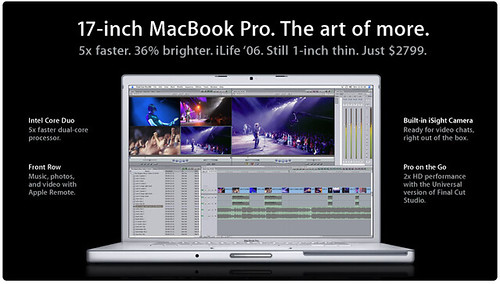
It has the following differences from the high-end 15.4″ MacBook Pro ($2500 retail):
- 17″ 1680×1050 display vs. 15.4″ 1440×900 display (my current 1.5Ghz Powerbook G4 is a 17″ 1440×900 display).
- Firewire 800
- an extra USB port
- 8x dual layer SuperDrive instead of a 4x single layer SuperDrive
- 2.16 Ghz Intel Core Duo instead of 2.0Ghz
- 120GB 5400rpm HD instead of 100GB 5400rpm HD
Here is a strange quirk. If you build-to-order the latter with the last two additions (2.16Ghz processor for $300 and 120GB HD for $100), it ends up costing $100 more than the 17″ computer. So you can get a larger screen, firewire 800, dual layer higher speed burner, and an extra USB port for $100 less!
(I figure the Firewire 800 addition is because the better heat dissipation qualities of the larger notebook. If that is the case, I wonder if they stopped underclocking the video chip in this model. I’d have thought the dual layer burner in a 17″ would only be because it was thicker than the 15.4″, except that it isn’t—they’re both 1 inch thick. This specification may have a lot to do with the target market (video) and their penchant to be willing to pay for the top of the line.)
This means that the 17″ MacBook Pro is a good deal (or the 15.4″ MacBook Pro is a bad one).
I feel it’s probably a bit of both. The 15.4″ “maxed out†is a bit overpriced, IMO, when you compare it to PC notebooks. Oh, if you max them out, then the price gap doesn’t seem so bad. Still you can get Core Duo PC notebooks for about half the price of the entry Mac Book Pro ($2000). You give up stuff like a widescreen display, and video performance. The construction is crap also (plastic, prone to failure, no backlit keyboard, no battery readout, shitty latch, poorly designed power supply, no slot loading, no magsafe connector) but that all falls into the “you get what you pay for†thing.
Having used my 17″ powerbook for a couple years now, I can safely say I don’t know how people manage to live with their 17″ PC notebooks. I’d say the 17″ Powerbook (1 inch thick, 6.9lbs) is barely practical (a little past the edge of what is comfortable). It barely fits into my Kata photo bag, and the laptop bag selection for it wasn’t as wide—the bag I chose won’t fit in my panniers on my bicycle commute. These high-end 17″ PC notebooks make mine appear svelte and light by comparison.
In other words, I wouldn’t consider a 17″ notebook any bigger and heavier than I have, at any price. So I’d say compared to its 17″ competition, the 17″ Mac Book Pro (1 inch thick, 6.8lbs) is a very good deal indeed.
(For instance, you can spec a Dell Inspiron with the same lcd, memory card, graphics, burner, and hard drive and pay $2851 for it (there is no Lattitude that big). It weighs 8 lbs and is over 50% thicker. Savings? Umm, no, it’s –$52. And that’s not including comparing the software bundle. Of course, as an earlier article, you can just buy the entry model for $2000 and wait for some other discounts. But then you have an overpriced plastic PINO—portable in name only)
Guessing wrong
Up until last week when rumors started flying about this announcement, I was betting any takers that the 17″ MacBook Pro wouldn’t come out until early August. Guess I was wrong. Good thing nobody took me up on it.
Why August? I figured the the Merom will be out by then and the date coincides with WWDC 2006. I still might be right about this, but the big splash for WWDC will have to be the new Intel-designed Intel-based Mac Pros (Intel “PowerMacâ€). (If you are wondering why the Pro Mac desktop will be the last model line migrating to Intel, read this article.)
No matter what, one of the consequences of migrating to Intel is that Apple will have to rev their top-of-the-line as soon as Intel releases their chips, if only to compete with the other PC manufacturers out there. If Merom is ahead of schedule (end of Q2 2006), then this means that they’ll have to rev the MacBook Pro line again in July. Releasing at NAB and shipping now will give this computer 3-4 month life cycle.
Looking ahead to Merom
The next chip will be slightly faster (up to 2.33Ghz instead of 2.12Ghz), support hardware virtualization (something that might be taken advantage of in the next Mac OS X “Leopard†which will be demo’d at WWDC), and be 64-bit. The new design means a slightly longer battery life, a slightly higher clock speed (as noted above), or (more importantly at this point) it won’t run as hot.
Since it is pin compatible with the current Core Duo’s it means that two new Mac Book Pros can be released without any redesign. That’s pretty good because the next interesting thing to put into a notebook will be a Blu-Ray or HD-DVD burner—that won’t be for a year.
The sequel to the Merom will be the Penryn. Since it is a 45nm process (as opposed to 65nm), I guess we can expect to see a big jump in clock speed (or conversely) battery life.
Hmm found a similar discussion on Flickr and I said my piece.
My piece:
20" notebooks aren’t far fetched. Dell has a 19" notebook I believe.
Umm similarly spec’d Dell (“lessen spec than a Dell†or whatever BS is floating around).
Dell has a 17" Latitude? Since when?
Okay let’s similarly spec a Dell 17" Inspiron (large and heavy piece of shit) and see what we get. (U.S.)
$1928: 17" Inspiron 9400
+$500: 2.15Ghz Core Duo
+$179: ATI Radeon X1400
+$149: UXGA resolution
+$35: 120GB 5400rpm
+$60: 8x dual layer
====
$2851
US Price of 17" MBP: $2799.
(The Dell comes bundled with a 3 year warranty. That costs extra for AppleCare. Having used both for over a decade, I won’t even begin to compare the two. If you know Dell’s system, you can chuck the warranty and save $70.)
(I’m not 100% sure about the "UXGA" stuff. I’ve never heard of it before when used for a wide screen display. UXGA is 1600×1200 (not wide screen). Apple’s 17" MBP LCD is WSXGA 1680×1050. WUXGA is 1920×1200. For reference, my current Powerbook is a piddly WXGA+ 1440×900, which I think is what Dell’s base Inspiron is. Feel free to correct me if I’m wrong.)
(The same also goes if you feel that a ATI X1400 in the Inspiron is better than an ATI X1600 in the MacBook Pro.)
(I’m also not sure where the Inspiron stands on gigabit ethernet, dual-link DVI, bluetooth, built-in camera, remote, and Firewire 800. But on the other hand you get really useful stuff a built-in modem, extra USB and FW ports, s-video, and analog video outs. All stuff that there are adapters for. *snort*)
I’m not saying that you can’t save money by buying a shitty 17" PC notebook and stripping it bare. I’m just saying that claiming to save about $750 on a 17" PC notebook with similar (or better) specs is a bit of a stretch.
My opinion, and yes, you can find other deals but that isn’t the point.
Size is key here imo. A maxed out 15″ would be better for me than any 17″…
Our designer just ordered hers… damn, another year before my lease is up.
Rob,
Good point!
I think 15″ is the ideal size for most people (especially non-graphics people like programmers). I harsh my 17″ powerbook’s size all the time (even in the article above).
But I stand by my statements above because the 15″ with the same spec should be cheaper than a 17″ notebook.
Ryan,
Yeah, I’m sort of torn. On one hand, I don’t have a lease and the 17″ 1.5Ghz G4 PB (which I only have because my old PB was stolen) blows for Aperture. Besides, the extra resolution and bright display… good thing.
On the other hand, you can bank on a minor upgrade to the Merom chip in a few months, there are a lot of kinks currently with the 15″ MBPs: not all apps play nice with the Intel version of the OS, driver support is flakey, there are some severe heat issues (and underclocking) going on. Also apps like Photoshop run better on my current hardware than the MBP, and that won’t change until early 2007 anyway.
The remote is a non issue (I have a bluetooth Palm and Salling Clicker) and neither is the built in iSight (Caitlin lives with me so no need to video conference anymore).
So, I’ve convinced myself that while the current model is a “good deal†I really shouldn’t pull the trigger on my credit card just yet.
(It’s like seeing that Best Buy in stock deal for the Nikon D200. Yeah, I know it’s not going to get that much cheaper anytime soon, but how many photos have I taken with my D70 recently? And I know that a new kit lens (18-200mm VR) or a replacement compact digicam, or even a MBP to run Aperture at a decent speed will have a larger impact on it than a D200.)
MacWorld publishes benchmarks.
Two things worth noting. First is the extra 5 fps on the Unreal Tournament benchmark and second is the Final Cut Compressor benchmark in which a dual Core G5 still ass-whups the Core Duo.
The first, I suspect, implies that the GPU in the 17″ MacBook Pro is not underclocked like it is in the 15″.
The second (along with other Altivec-biased marks like iMovie filter and iTunes encode) show why there is no “Mac Pro†(replacement for the PowerMac G5). Until the quad-core or multi-CPU core duo’s come out, the G5 is still the king when money is no object.
This will change come August. 🙂
One thing I forgot to mention about the Merom is it will be slightly more efficient per clock cycle so the Mhz numbers don’t translate straight across. I’ve heard a number “20% more efficient” but I think that’s optimistic since the Core Duo is 20% more efficient than the Pentium 4–20% sounds way too big in that light.